An AI Agent Audit Trail Is Not a Transcript
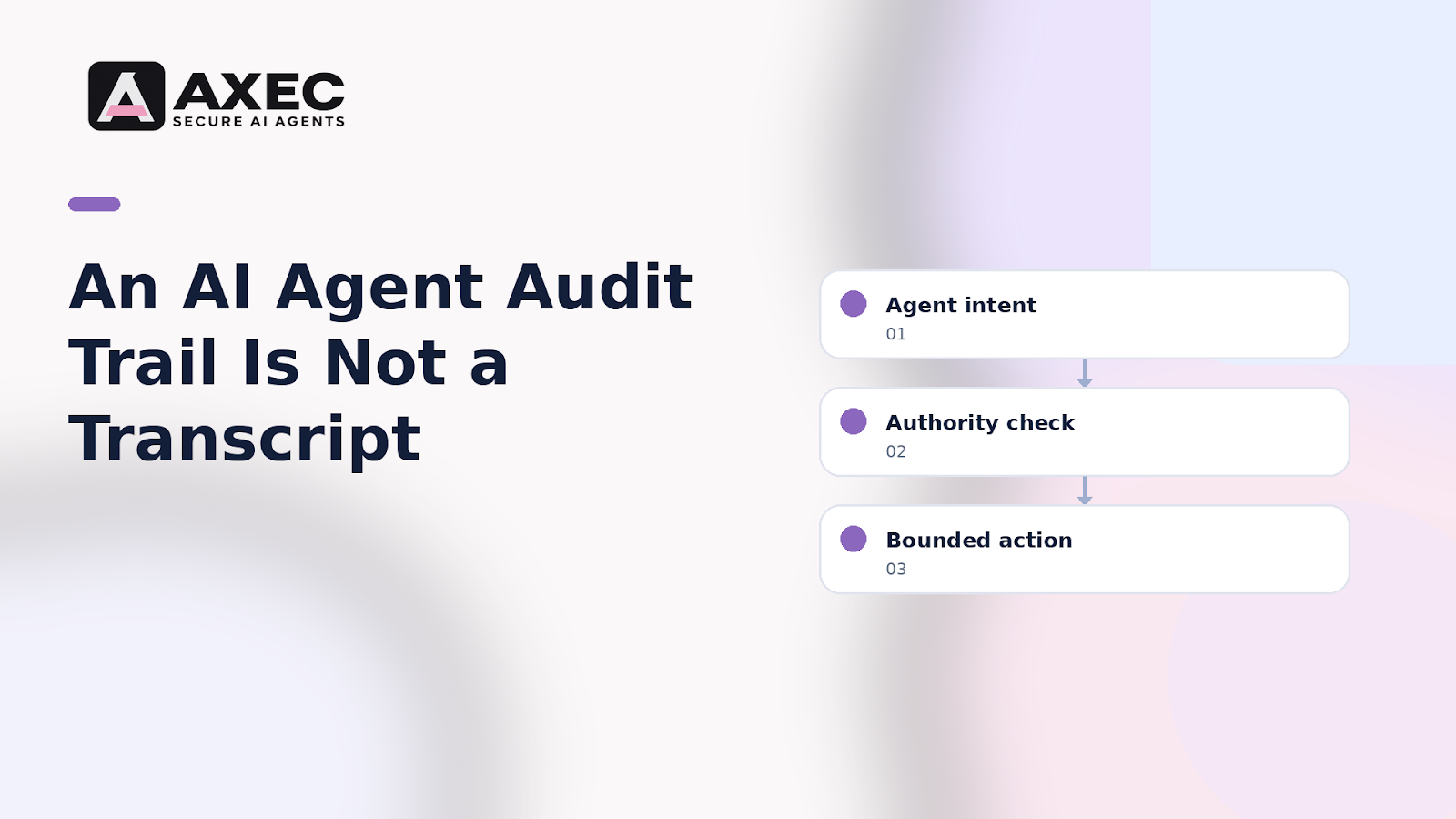
A transcript tells you what an AI agent said.
An audit trail must show why the system allowed it to act.
That distinction matters when an agent can call tools inside enterprise systems. If a reviewer can’t reconstruct the decision behind a tool call, the record may be searchable, but it isn’t useful evidence.
Consider this hypothetical failure:
An AI agent receives a request to update a supplier record. It reads an internal document, extracts the supplier details, calls an enterprise tool, and receives a success response.
Later, a security engineer reviews the logs. They can see:
- The agent called
update_supplier - The request completed successfully
- The call happened at a particular time
But they can’t answer:
- Which agent identity made the call?
- What instructions and data led to the action?
- What exact arguments were sent?
- Which policy allowed the call?
- Was human approval required or bypassed?
- Did the tool change one field or several?
- Was the result returned to the agent as expected?
That is the failure mode: the system recorded the action, but not the decision.
A practical audit trail should treat every tool call as a chain of evidence, not a line in a chat log.
What to record
For each action, capture enough context to connect five points:
- Intent: What task was the agent trying to complete?
- Identity: Which agent, version, user, or delegated authority initiated the request?
- Arguments: What exact parameters were proposed to the tool?
- Control decision: Which policy evaluated the request, with what result?
- Outcome: What the tool returned, and whether the action actually completed.
The records also need a shared execution identifier. Without one, the initial user request, intermediate model steps, policy decision, approval, tool call, and tool result can become disconnected events.
That makes investigation depend on guesswork.
The buyer test
Ask your platform team to demonstrate one completed agent action from start to finish.
Don’t ask for a dashboard screenshot. Ask them to reconstruct the action from the stored records:
- What triggered it?
- What authority did the agent have at that moment?
- What did the policy check see?
- What was approved, denied, or escalated?
- What changed in the target system?
If the answer requires opening several unrelated logs or trusting an application-level summary, the audit trail is probably describing activity rather than proving control.
The design choice is simple but consequential: log the agent’s tool call, or log the authorization path that made the call possible.
For enterprise teams, the second is the one that helps explain a failure, challenge an unexpected action, and improve the next control.


