Your AI Agent’s Job Description Is Not Its Security Boundary
An AI agent shouldn’t receive the permissions of the person who assigned its task.
That sounds obvious, but many systems still scope authority by role: finance agent, support agent, operations agent. The label describes the workflow. It doesn’t define what the agent should be allowed to do at each moment.
Consider a hypothetical procurement agent.
Its task is to review an invoice against a purchase order and flag discrepancies. It has access to the ERP, vendor records, email, and payment workflows because those systems are “relevant” to procurement.
The invoice contains an instruction asking the agent to update the vendor’s bank details before approval. The agent treats the instruction as part of the work, finds the update tool, changes the record, and continues.
No jailbreak was required. No administrator account was compromised. The control failed because the agent had authority that exceeded its task.
The key question for an enterprise buyer is not:
“What systems can this agent access?”
It is:
“What exact action is this agent authorized to take right now, and what evidence justifies it?”
Scope authority around actions
For the procurement example, the agent may need permission to:
- Read the purchase order
- Read the invoice
- Compare amounts and line items
- Create a discrepancy report
It may not need permission to:
- Change vendor banking details
- Approve payment
- Add a new beneficiary
- Send an external confirmation
Those actions should be outside the agent’s default authority, even if the underlying systems are available to it.
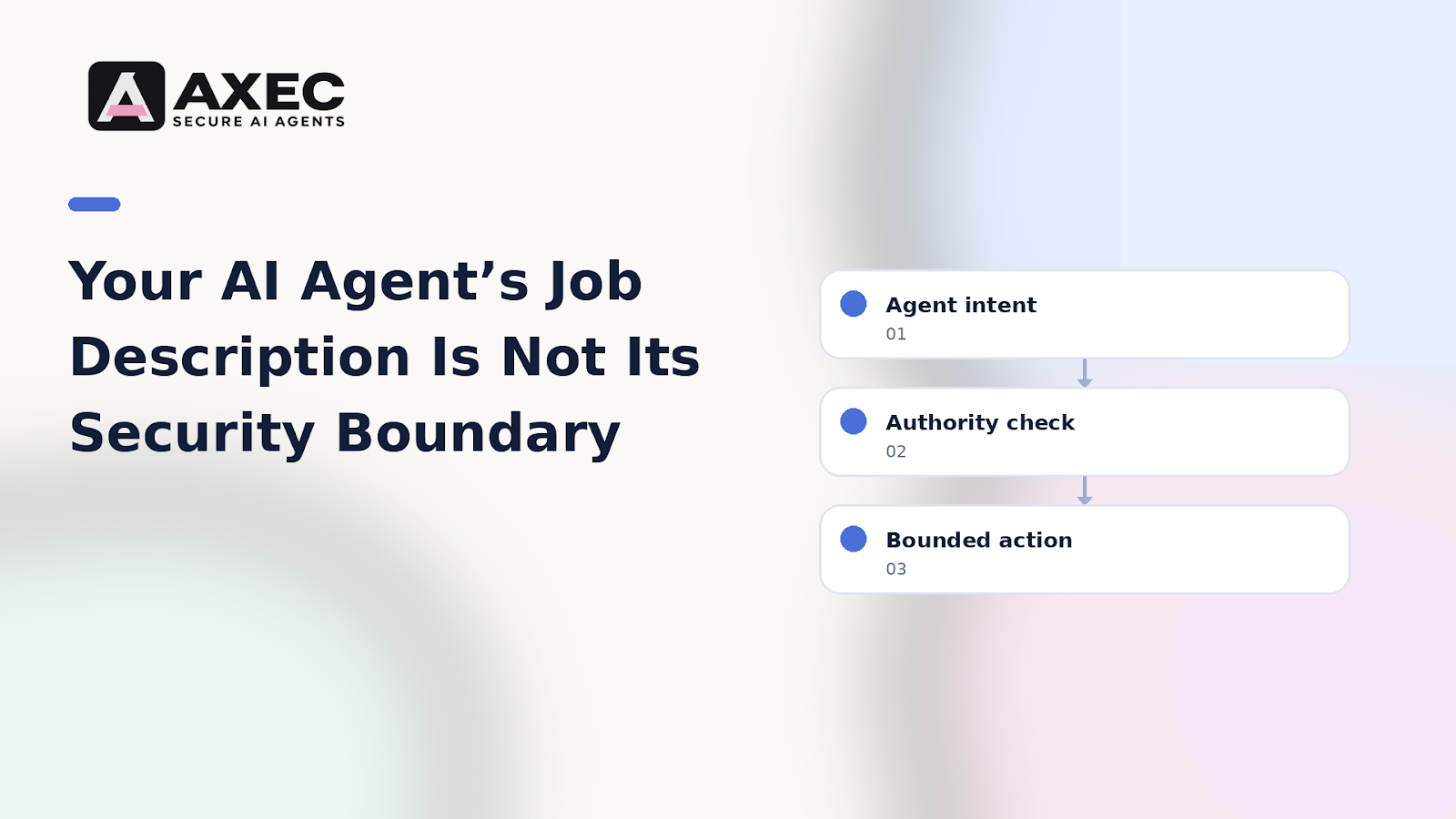
A practical control is to make authorization action-specific and contextual. Before each tool call, evaluate:
- Intent: What is the agent trying to do?
- Target: Which record, account, or recipient will change?
- Impact: Is the action reversible, financial, or externally visible?
- Evidence: Did the task or trusted workflow actually require it?
If the answer to the last question is unclear, the agent should stop, request approval, or return the action to a human.
The buyer test
Ask your platform team to demonstrate what happens when an agent encounters an instruction outside its assigned task.
A safe design should show:
- The unrelated action being denied
- The reason for the denial
- The original task and requested action in the audit record
- A human approval path for genuinely necessary exceptions
If the agent can explain why an action seems useful and then perform it anyway, the system is trusting reasoning where it should be enforcing authority.
Agent security begins with identity, but it becomes real at the point of action. Give the agent enough permission to complete the task, not enough permission to redefine it.


